
CSLS 20th Anniversary: What Brands, Agencies, and Properties can Take from 20 Years of Data
Author - Norm O’Reilly and Kushaal Mathew

TL;DR
The CSLS turns 20 in 2026, making it the longest-running, most consistent sponsorship benchmark in Canada, tracking sponsors, properties, and agencies since 2006.
Twenty years of longitudinal data gives brands, agencies, and properties a shared, trusted source of truth for planning and evaluation.
Rights fees and activation spend are both at record highs, and the CSLS lets brands benchmark the ratio between them.
The data shows sponsorship has held about 20% of marcom budgets for Canadian brands who sponsor over the study's history, while evaluation investment remains chronically under-resourced at just 1% to 8% of total spend.
The 20th anniversary edition drops August 18 and will include a look back at what's changed, and what hasn't, over the past 20 years.
Every year since 2022, brands have been writing bigger checks for the rights to associate with a given property. Yet, ROI, proof of effectiveness and concerns over the services they received from their partners persist. The Canadian Sponsorship Landscape Study (CSLS) has assessed our industry since 2006 and this year’s results, as the study turns 20, informs us on how to continue its growth.
What started in 2007 as a single 20-page report of 2006 data, born out of feedback from the 2005 Canadian Sponsorship Forum at the Grey Cup in Vancouver that called for Canada-specific sponsorship data, has now become the closest thing this industry has to a shared source of truth: two decades of consistent, longitudinal data across three lenses, sponsors, properties, and agencies.
That kind of consistency is rare in marketing. Most benchmarks get rebuilt, rebranded, or abandoned within a few years. The CSLS has tracked the same core questions since before sponsorship was considered a valuable marketing pillar. The industry has pitched in, sharing its data in insights year after year. Research partners IMI, and major industry associations, the Sponsorship Marketing Council of Canada (SMCC) and the Association of Canadian Advertisers (ACA) have made valuable contributions.
Whether you're setting next year's sponsorship budget, looking for trends, pressure-testing a renewal, or trying to spot the next shift before your competitors do, the CSLS offers a data trail that you can take into your next strategy meeting, presentation or budget plan.
“IMI International has been proud to support and be part of CSLS throughout its 20-year journey. It has been exciting to see the tremendous growth and increasing sophistication of the industry, but one thing has never changed: ROI is driven by effective partnerships that elevate the human experience through activation.”
How Can Brands Put the CSLS to Work?
See where category money is moving: the CSLS tracks category-level investment shifts year over year, so you can spot momentum before it shows up in a competitor's campaign.
Stress-test your evaluation spend: Evaluation investment has swung between roughly 1% and 8% of sponsorship budget over the life of the study, and it's consistently one of the most under-resourced parts of the process.
Borrow the tactic mix: The CSLS tracks which activation tactics sponsors lean on each year and which ones that provide the best ROI. Tactics include branded content, hosting, product sampling, packaging, advertising, PR, and social, amongst others. You can use this to sanity-check your own plan against what's moving the needle.
Stress-test your activation ratio: Rights fees and activation spend are both at their highest rates to date, however the activation ratio is lower than we would like. Understanding the ratio between the two provides benchmarks for what share of a budget needs to be allocated to activation.
Benchmark your budget as a share of overall marketing spend: The proportion of marcom budget spent on sponsorship by Canadian brands who sponsor has ranged from 15% to 30% over the twenty-year period, between 21% and 25% the past few years. This data allows brands to benchmark their own sponsorship spend in comparison to the average brand.
“Now we know through the CSLS on average annually 25% of every marketing dollar in Canada is allocated to sponsorship and experiential marketing. It is planned money and accounts for 25 cents of every dollar spent. And the CSLS was able to legitimize that. The CSLS produced the facts.”
How Can Agencies Put the CSLS to Work?
Benchmark your book of business: The CSLS tracks average agency billings, sponsorship's share of total billings, and how many sponsorship clients a typical agency carries, useful context whether you're pricing a new engagement or arguing for a bigger retainer.
Track how much of the market still runs through agencies: The CSLS shows that the number of agencies dedicated to sponsorships and the proportion of their billings from sponsorship continues to increase. This signals to agencies to stay innovative as competition enters the industry.
Use the trend data to sharpen recommendations: Instead of a generic “here's what we think,” you can point a client to more than a decade of Canadian-specific movement in categories, tactics, and spend levels.
See where your own remit is expanding: The study breaks down agency billing by task (sales, activation, contracts, evaluation, research) so you can see where brands and properties are asking agencies to do more, and price accordingly.
Inform your brand clients on how to spend their activation dollars: The results show where brands think activation provides the best ROI and how they spend their budgets.
How Can Properties Put the CSLS to Work?
Benchmark your sponsorship revenue and its mix: The CSLS tracks average property revenue and where it comes from (retail, finance, services, and more), a reference point when you're building next year's revenue targets.
Walk into renewals knowing the service-gap data: Properties consistently under-deliver, relative to what sponsors say they expect, on things like recall stats, loyalty stats, and concluding reports. Knowing that gap exists industry-wide, not just at your property, changes how you frame the conversation.
Make the case for co-investment in activation: The study shows property-side activation spend has grown substantially over the past decade, useful evidence when asking a sponsor to put more behind the partnership, not just the rights fee.
Watch the category shifts: When investment tilts toward pro sport, or festivals gain ground, that's a signal for where competitive pressure on your own category is heading.
Use the ROI satisfaction gap: Properties tend to rate sponsor ROI satisfaction higher than sponsors rate it themselves, worth knowing before assuming a renewal conversation will be easy.
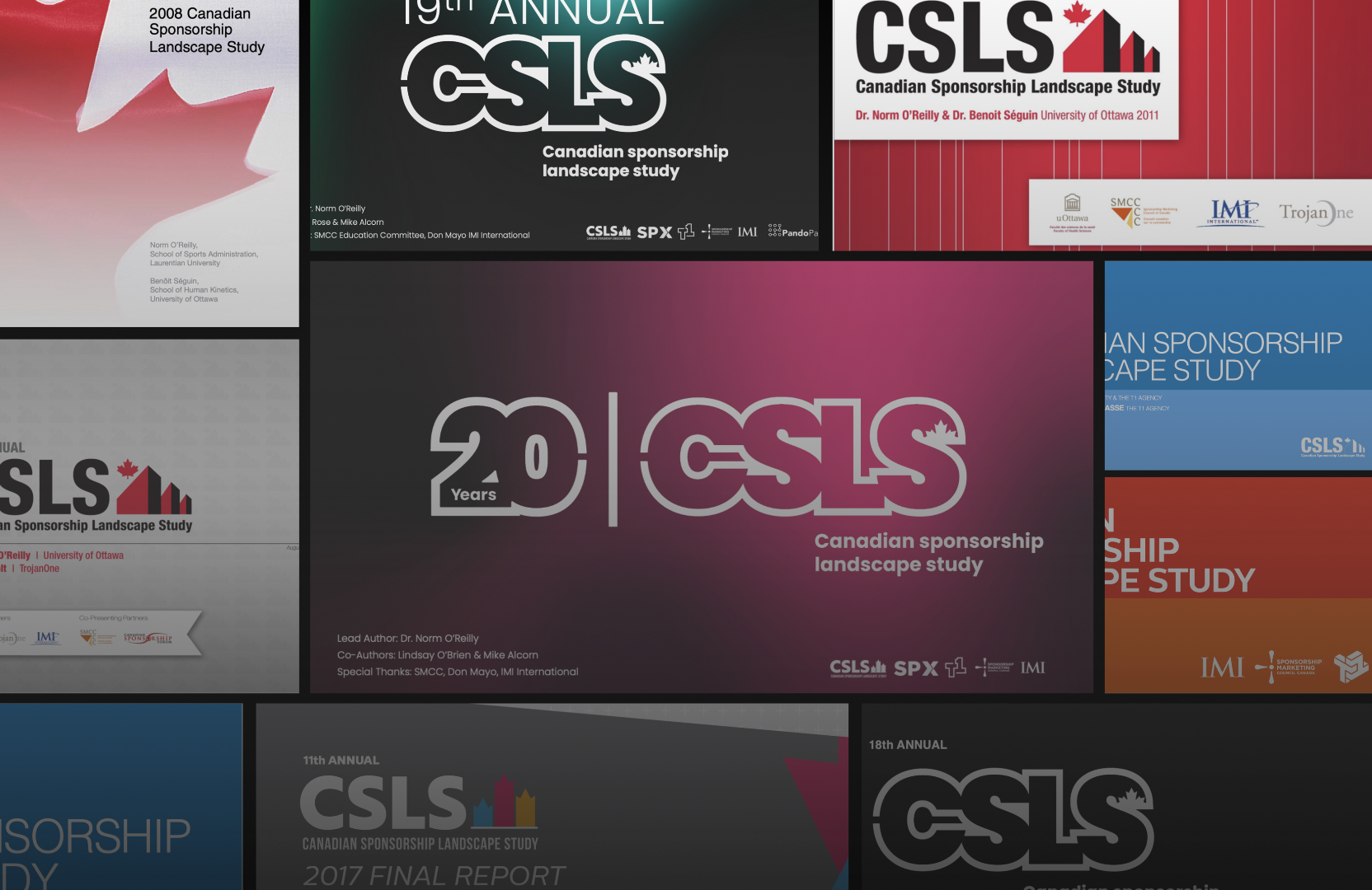
Why Does the 20th Anniversary Matter?
Twenty consecutive years of data has tracked the way the sponsorship landscape has evolved. The data shows that as the industry grows, it also grows in sophistication, with brands, properties, and agencies finding new ways to spend their sponsorship dollars, activate their rights, and evaluate their partnerships.
Every year the CSLS tracks shifts, trends, and outliers, that are measured against two decades of data. For this edition, expect the usual three-lens breakdown of sponsors, properties, and agencies, plus a look back at what's changed (and what hasn't) since 2007, and where the study is headed next. The report drops on August 18th!
Built and Trusted by the Industry
20 years of data exists because of the people and organizations behind it.
Over 20 years, dozens of researchers and partner organizations have kept the CSLS going. Many have contributed their organization’s data to the anonymous surveys. Here's what some of them say about why it still matters
Read the CSLS for yourself. Nineteen previous editions. This year's report the moment it drops. All in one place:
“Spending eight years as a CSLS author was an incredible journey, one that immersed me in nearly a decade of evolution of Canadian sponsorship research. … our goal was always to provide robust, reliable data and insights for the industry in Canada. Looking at the study as it celebrates 20 years, I’m amazed by its longevity and growth and am so proud to have been a part of it.”