
20 Years, Five Eras: What Canada's Best Sponsorship Data Shows
Authors - Kushaal Mathew, Volodymyr Nazar, and Norm O’Reilly
TL;DR
Canadian sponsorship spend grew from roughly $1.1 billion in 2006 to a record $4.22 billion in 2024.
The industry's 20-year history breaks into five distinct eras, each defined by a different growth driver: activation, festivals, pro sport's scale-up, the pandemic reset, the optimization
Activation spend hit an all-time ratio of 1.01:1 against rights fees in 2023, the first time in CSLS history that activation exceeded rights fees, which is considered an industry standard.
Each era added a new capability the last one lacked: (i) activation, (ii) experiential marketing-driven category diversification, (iii) scale, (iv) resilience, and now (v) optimization.
Category mix has diversified well beyond pro sports, with festivals, entertainment, Olympic sport, and more all taking slices of the market.
60.6% of sponsors are planning increased investment in women's sports this year over last year.
The 20th anniversary CSLS launches August 18, 2026, marking two decades of data on Canada's sponsorship industry.
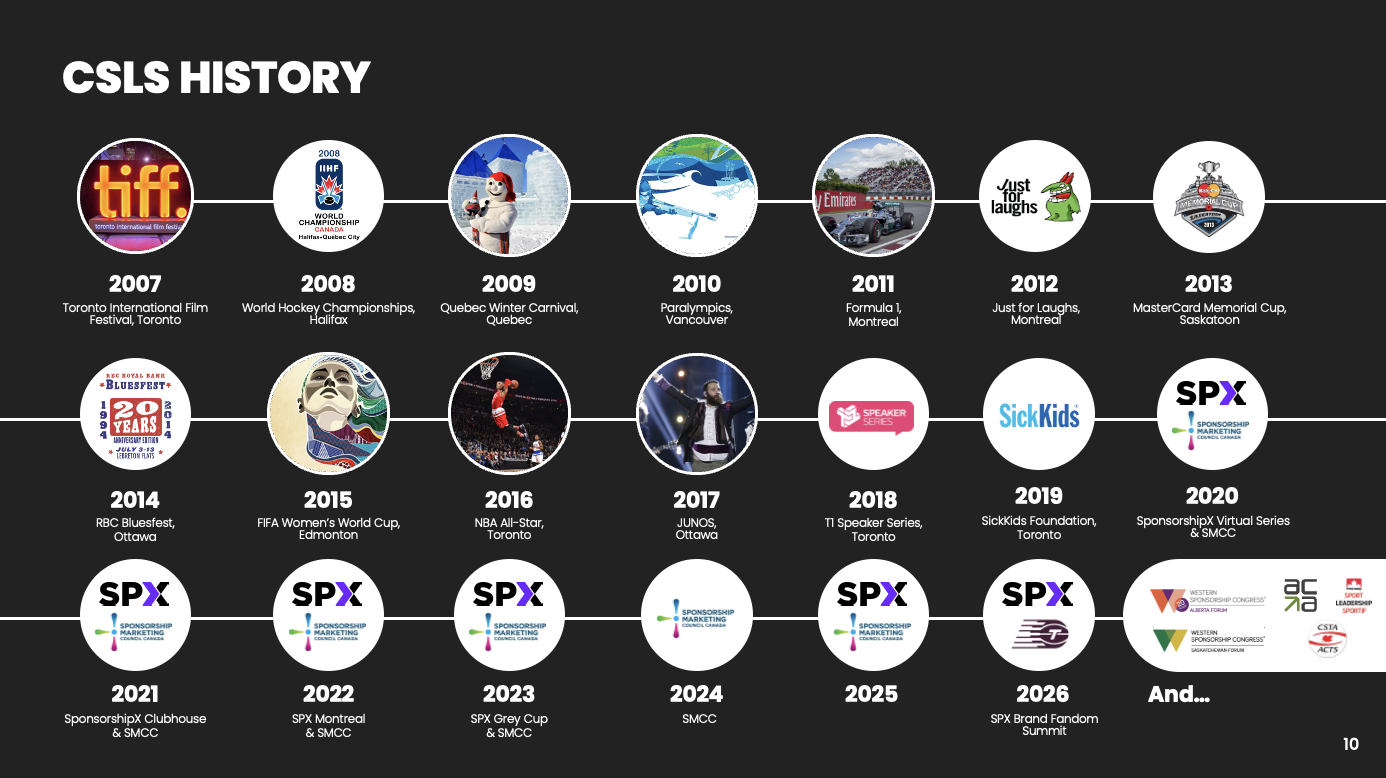
Our last post covered how brands, agencies, and properties can put 20 years of CSLS benchmark data to work today. This time, we're going back to where it started. The study launched in 2006, sparked by delegates at the 2005 Canadian Sponsorship Forum in Vancouver who wanted real data on how Canadian brands invest in sponsorship. Twenty years and 19 annual editions later, the 20th anniversary edition arrives August 18, 2026, at SponsorshipX. As the industry inches closer to the $5 billion size estimate, looking back on its history reveal some telling signs on where its headed next. What happened in between wasn't one long trend line. It was five distinct eras, each with its own defining shift.
2006 – 2011: What Did the Early Years Prove?
The early CSLS editions answered a basic but unproven question: does sponsorship hold up under pressure? It did. Through the 2008 to 2009 recession, the share of marketing budgets brands spent on sponsorship averaged 18.95%, steady even in a tight marketing environment, showing that brands stuck with sponsorship in tough times. As a result, total industry spend climbed 39%, from $1.11 billion to $1.55 billion, between 2006 and 2010. Another early finding was less flattering: Canadian brands were investing far less in activation than the rest of the world, spending just $0.43 per dollar of rights fees in 2006, versus studies in the US at the time showing ratios above 2:1. That gap became the industry's first real call to action. The 2010 Vancouver Olympics gave amateur sport sponsors a proving ground, with 13.8% of them allocating an average of 26% of their sponsorship budget directly to the Games.
2012-2015: How Did Festivals Change the Investment Mix?
By 2012, festivals had momentarily overtaken professional sport as Canada's leading sponsorship category, growing 524% in spend since 2006 and claiming 24.3% of total rights fees at the time. We dubbed this “festivalization”. In 2013, brands spent $419 million on festivals versus $361 million on sport, the second time in 20 years, festivals came out as the top property type of choice. Social media activation spiked over the same window, jumping from 3.9% of activation budgets in 2009 to 16.1% in 2012, before falling back sharply. Then pro sport reasserted itself as the dominant category. Rights fee spending surged 82.5% year over year in 2014, and by 2015 professional sport hit a 10-year high of $751 million, or 38.5% of all Canadian rights fees.
2016-2019:What Powered the Industry Past $3 Billion?
Pro sport's renaissance kept building. By 2018, it accounted for an estimated $990 million, more than half of total sponsorship spend, while rights fee investment overall climbed steadily from $1.59 billion in 2011 to $1.99 billion in 2019. That same year, total Canadian sponsorship spend, rights fees plus activation, broke the $3 billion mark for the first time, reaching an estimated $3.02 billion in 2018. Activation investment more than doubled over this period, up 156% since the study began. This was the industry at its most confident: growing every year, diversifying its categories, and treating activation less as an afterthought and more as a core strategy.
2020-2022: What Happened When Live Events Stopped?
We learned that the sponsorship industry is recession proof but not pandemic proof. COVID-19 hit sponsorship harder than almost any other marketing discipline. Total spend collapsed by over 52%, from $3.14 billion in 2019 to $1.49 billion in 2020. Rights fees fell below $1 billion for the first time in a decade, and 51.6% of properties reported reinvesting nothing into activation that year because there were no events left to activate around. Sponsor satisfaction with ROI dropped to a historic low of 2.8 out of 5. But the pivot to digital and social happened fast, and the tactics properties and brands built under pressure became permanent parts of the sponsorship toolkit once events came back.
2023 - 2025: The Age of Optimization
The rebound has been dramatic. Industry spend hit a record $4.22 billion in 2024, is expected to rise again in 2025. In 2023, the activation ratio reached an all-time 1.01:1, the first time in CSLS history that activation spend exceeded rights fees. Properties responded to years of strained relationships by investing more in sponsor servicing, up from 10.4% in 2017 to 18.9% in 2024, and brand evaluations of that servicing hit their highest ratings in the study's 19-year history. Brands, meanwhile, poured resources into evaluation itself, more than quadrupling pre-2023 spend to reach 14.3% of rights fees by 2024. Categories have kept diversifying too, with 60.6% of sponsors now planning to increase investment in women's sports. Sponsorship is an industry that has stopped guessing and started measuring.
“Sponsors, properties, and agencies are making more strategic, data-informed decisions, with greater emphasis on long-term value creation, meaningful fan engagement and measurable impact”
What Two Decades of Data Means for Brands Today
Line up the five eras and some patterns emerges: every real gain came from brands investing more deeply in the communities and experiences their sponsorships actually touch, not from spending more on rights fees alone. Activation, festivals, pro sport's scale-up, the pandemic reset, the optimization boom: each era pushed the industry to build a capability the last one didn't have. At T1, this is the thinking behind everything we build: partnerships designed around community and measurable return on objectives, not just rights fees and impressions. Twenty years in, the era that matters most is the one your brand is building toward next.
Want the full 20-year picture? The 20th anniversary CSLS launches August 18, 2026, at SponsorshipX. Read all 19 previous reports by following the link below!